
Eight different commercial operations depend on professional adventure equipment, and they look at the same catalogues from radically different starting points. A climbing gym manager thinks in wall-utilisation percentages. A summer-camp director thinks in seasonal robustness and operator turnover. A wind-turbine training centre’s procurement officer thinks in EN 360 and fall-arrest documentation. The gear in front of all three may share the same magnetic-braking technology — but the right specification, the right certification, and the right service plan vary considerably.
This guide is written for operators in the procurement seat. It works through eight industries that depend on professional adventure equipment, what each one actually needs from the gear, and where the meaningful trade-offs sit.
Jump to your operation
- Climbing gyms
- Adventure parks and ropes courses
- Family Entertainment Centres
- Schools and universities
- Recreation and leisure centres
- Summer camps and outdoor education
- Professional training and work-at-height
- Dropped object prevention
The four pressures that shape every buying decision
Before specifying anything, it’s worth naming what every commercial operator is optimising for. Across eight unrelated venue types, the same four pressures keep showing up:
- Operational efficiency — staff time per participant, inspection cycles, fewer touchpoints per cycle
- Visitor engagement — repeat visits, perceived quality, time on attraction
- Throughput maximisation — participants per hour, queue dynamics, transition speed
- Revenue growth through compliance — EN-standard certification, insurance position, downtime control
Use this lens on every spec sheet. If a feature doesn’t map to at least one of the four, it’s decoration. If a feature maps to three or four at once — auto belay, continuous belay, automatic-reset braking — it’s almost always the right answer for high-volume commercial operations.
Climbing gyms: auto belay as a wall-utilisation multiplier
The defining number in a climbing gym is wall-utilisation: the percentage of available climbing minutes actually being climbed. Traditional belayed walls stall well below their theoretical capacity outside peak hours because every climber needs a belay partner. Auto belay removes that constraint — a climber walks up, clips in, and starts climbing without a partner, instructor, or booking.
The operational consequences are direct. Group bookings stop hinging on the belay-certified staff roster. Children’s parties no longer require one instructor per pair of climbers. Walk-in conversion rises because the experience starts in seconds rather than minutes. Membership retention improves because climbers can train alone at off-peak hours.
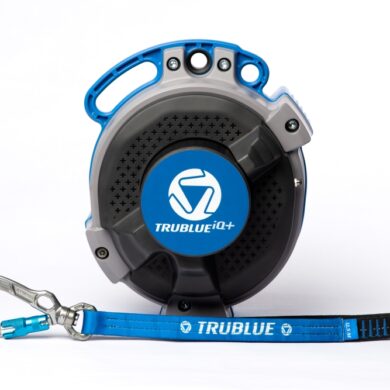
For most commercial gyms, the TRUBLUE iQ Auto Belay is the default specification — magnetic braking, no friction parts to wear, certified to EN 341 with the 10× Class A and shock-load extensions. The TRUBLUE iQ+ adds catch-and-hold for advanced training and route-work. TRUBLUE Speed is a separate product for IFSC-compliant speed-climbing lanes; never specify it for general climbing because the retraction rate is wrong for that use case.
Service economics matter on a wall full of devices. Magnetic braking has no contacting parts, which means the consumable cycle is dominated by webbing replacement rather than internal wear. Annual service is a regulatory expectation, not an upsell, and gyms running ten or more devices should budget the Zero Downtime Auto Belay Service Program to keep all lanes running through swap cycles.

Adventure parks and ropes courses: throughput across the whole circuit
An adventure park is a portfolio — ropes courses at various difficulties, ziplines of different lengths, sometimes a free-fall element, sometimes a climbing tower. The equipment problem is that no single product family covers the whole park. The specification problem is that every element has to play with every other element: same harness, same connector standard, same staff-training programme.
The defining metric is participants per hour across the whole circuit, not per element. A bottleneck at one transition kills throughput across the park, which is why continuous belay technology has moved from optional to expected for new builds and major refits. Eliminating the unclip-and-reclip step at every transition lifts hourly throughput meaningfully on multi-element courses, with the secondary effect that staff are freed from supervising connector swaps and can run rescues and customer service instead.
The belay-system choice anchors the rest of the spec. Four families dominate the European market, and the trade-off between them is operational, not abstract:
| System | Approach | How it works | Best fit |
|---|---|---|---|
| SafeRoller | Continuous belay | Trolley runs along the safety cable; participant stays attached throughout the circuit | High-volume courses with many ziplines and transfers; modern new builds |
| Speedrunner | Continuous belay | Kanhook Ultimate clip system enforces continuous attachment via an interlocking mechanism | Courses prioritising mechanical robustness and forgiveness for untrained users |
| LockD | Continuous self-belay | Clip-based self-belay using mandatory Tweezle tools for participant-managed transfer | Self-managed courses where participants operate transitions under staff supervision |
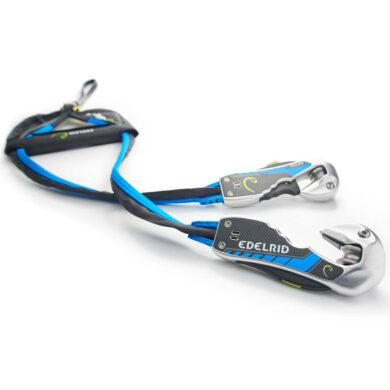
| Edelrid Smart Belay X | Smart belay (manual transitions) | Interlocking carabiners ensure one connector is always closed before the other opens | Retrofits and courses where continuous-cable infrastructure isn’t feasible |
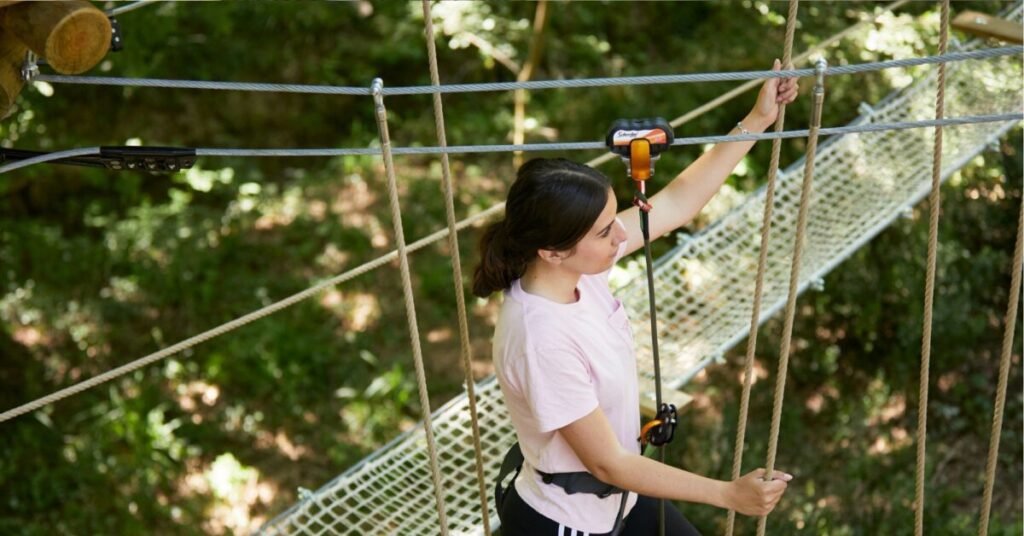
The question underneath all four is whether the course architecture supports continuous belay at all. Where it does, the throughput case is decisive. Where it doesn’t, smart belay matches the rescue protocol without forcing infrastructure changes.
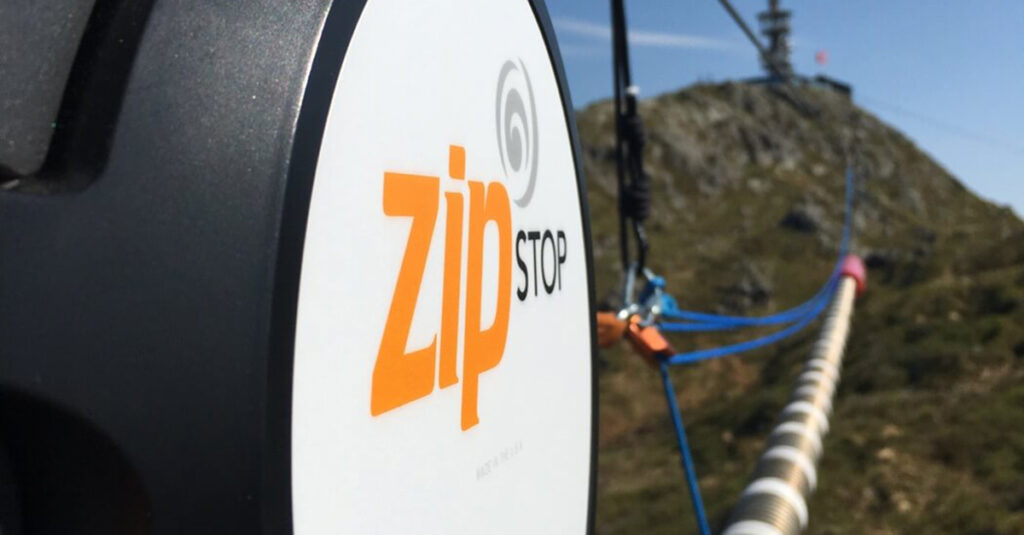
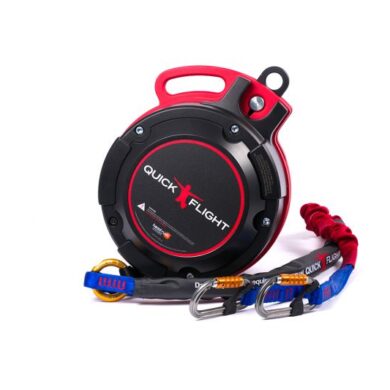
On the zipline side, modern parks use magnetic zipSTOP brakes with automatic reset and a trolley-return system to remove a staff member from the landing zone. EN 13796 compliance for cableway installations is non-negotiable for the European market. For free-fall jump elements, the QuickFlight family covers heights up to 4 metres; the Flightline covers tower jumps up to 11 metres and adds redundancy designed for high-cycle commercial operation.
One piece of advice saves the most pain: specify the harness, helmet, and connector standards before the elements. Operators who pick belay systems first and then discover their harness inventory won’t work with the new clips lose weeks of build time.
Family Entertainment Centres: climb, zip, jump without a belay school
Family Entertainment Centres run on indoor footprint, fast attraction cycles, and a customer base that isn’t there to learn. They’re there for forty-five minutes of activity between a meal and an arcade. The equipment has to deliver the experience instantly, with the minimum possible staff per cycle, in a climate-controlled space in use for ten to twelve hours a day.
Auto belay is the dominant climbing technology at FECs because it removes belay instruction entirely from the cycle. A short verbal brief, a connector check, the participant climbs. The magnetic braking that suits dedicated climbing gyms is even more important here because the duty cycle is brutal — an FEC wall may see 200+ climbs per device per day, every day, indoors. Devices without friction parts aren’t a luxury in that environment; they’re the only realistic specification.
Free-fall and zipline elements scale FECs into a wider price point. The QuickFlight family delivers a free-fall element with a controlled catch at heights that fit a standard indoor build. Short indoor ziplines with zipSTOP braking and automatic reset can run all day with one staff member on the launch and none on the landing.
The compliance burden is real and underestimated. FECs that grow from arcades into climb-zip-jump venues frequently discover that their insurance and inspection regime is sized for arcades, not for adventure attractions. Plan annual inspection budgets, EN 15567 documentation, and staff training cycles before the first device is bought, not after.
Need expert advice from the adventure specialists?
Get in touch Today
Schools and universities: campus rec under staffing pressure
Campus rec centres face a particular problem — very high variance in climbing ability across one user base, tight staffing budgets, and operating hours that stretch from breakfast to late evening. Auto belay solves a meaningful slice of this by allowing climbers across the experience spectrum to use the wall without a partner, without an appointment, and without booking belay-certified staff into every shift.
The secondary use case in higher education is the climbing programme itself: outdoor leadership classes, climbing-team training, route-setting research. Mixing TRUBLUE iQ for general open climbing with TRUBLUE iQ+ for technique work gives a programme room to grow without re-specifying hardware.
Universities tend to be conservative about inspection and documentation, which works in favour of magnetic-braking systems with manufacturer-direct service paths. The paper trail is clean, the inspection cadence is predictable, and the relationship with the device manufacturer survives staff turnover in a way that informal arrangements don’t.
Recreation and leisure centres: multi-use pressure on the climbing wall
Municipal and commercial recreation centres treat the climbing wall as one revenue element inside a multi-use facility. The wall operates alongside a pool, a gym floor, a children’s programme, and an events calendar — which means low-staff operation, flexible hours, and resilience to mixed usage are non-negotiable.
The specification follows directly. Auto belay for the primary climbing surface, durable webbing rated for high-cycle indoor use, and a service plan that doesn’t require pulling devices off the wall for weeks at a time. Multi-use facilities benefit disproportionately from the Zero Downtime model — the wall stays open through service swaps, which protects both the facility’s reputation and the climbing element’s revenue line.
Where rec centres differ from dedicated gyms is in the climbing-skills mix. Most users are casual or first-time, which makes the unassisted-ascent characteristic of magnetic auto belay valuable: the device doesn’t pull the climber up the wall, so the experience matches what climbing actually is. First-time climbers who experience the real climbing motion are more likely to return than those who experience a pulley ride.
Summer camps and outdoor education: built for seasonal operation and staff turnover
Camp operations are unforgiving on equipment. Devices live outdoors for the season, get exposed to rain, dust, sun, and inconsistent handling, then go into storage for half the year. The equipment specification has to assume that the operator running the device next summer may have just been hired last week.
Magnetic braking earns its place at camps for the same reason it does indoors: no contacting parts, no pads to inspect, no hydraulic seals to check. Outdoor ratings on TRUBLUE iQ and the zipSTOP family aren’t marketing language — they reflect real-world testing for the dust, temperature swings, and weather that summer programmes deliver every season.
The harder problem at camps is the human one. Camp staff turn over annually, and training time is short. Equipment that requires nuanced operator judgement is the wrong choice; equipment with automatic braking, predictable behaviour, and clear visual indicators of status is the right one. Auto belay, automatic-reset zipline brakes, and continuous belay systems all map to that constraint. Connector-and-lanyard systems that demand frequent operator intervention map against it.
Pre-season inspection deserves a separate line in the budget. Most camp incidents aren’t equipment failures — they’re operator-handling failures on equipment that was perfectly serviceable. A well-run pre-season inspection catches both: device-condition issues that built up over the off-season, and refresher signals for operators who haven’t touched the gear in nine months.
Professional training and work-at-height: same platform, different certification
The framing changes here. Adventure-park standards (EN 15567, EN 13796) give way to work-at-height and personal-protective-equipment standards (EN 341, EN 360, EN 363). The audience is safety officers and training managers, not park designers. The mechanical principle crosses over — the same magnetic-braking technology that catches a climber catches a worker — but the regulatory frame and the buying conversation are different.
Utility lineworkers, wind-turbine technicians, tower climbers, and rescue trainees all share one training problem: they need to practise fall-arrest scenarios repeatedly, in controlled conditions, with reliable catches. Auto belay technology configured for the professional environment removes the requirement for a dedicated belayer on every drill, which compresses training-day throughput significantly.
The device is the same magnetic-braking platform as the TRUBLUE auto belays climbers know from commercial gyms — sold into professional training as TRUBLUE SafeLine. The mechanical principle is identical: controlled, predictable catches with no friction parts to wear under high cycle counts. What differs is the certification frame. Adventure-park auto belays are certified under EN 341 with adventure-relevant amendments; professional training applications add EN 360 (retractable fall arresters) and the relevant national work-safety regimes.
Operators specifying for training-centre use should treat it as a procurement project distinct from any adventure-park spec they may already run. The professional category on Thrill Syndicate — descenders, fall arresters, work-safety harnesses, professional ropes — sits parallel to the adventure-park product tree and follows a different standards regime.
Dropped object prevention: the controlled-descent problem on equipment
Dropped object prevention is the same controlled-descent problem, applied to equipment rather than people. A power tool, a sensor package, or a piece of machinery raised to height needs to remain attached to a device that, if released, descends in a controlled way protecting everything below.
The device is — again — the TRUBLUE platform, configured and certified as TRUBLUE SafeLine for dropped-object and equipment-protection scenarios. The mechanism is identical to the climbing-wall version: magnetic braking that resists motion proportional to speed, no friction parts to wear, no nuisance lockups during the host equipment’s normal dynamic movement. What changes is the certification path — EN 341 for descender devices, EN 360 for retractable fall arresters — and the engineering frame around the install. Mass of the protected equipment, drop distance, environmental conditions, and host-equipment compatibility all shape the right configuration.
This kind of spec rewards being treated as an engineering project rather than a catalogue order. Thrill Syndicate’s design and engineering service handles dropped-object and controlled-descent procurement for operators working outside the standard adventure-park spec.
Three principles that hold across all eight industries
Match the equipment to the operational cycle, not the marketing tier. A TRUBLUE iQ isn’t “better” than a SafeRoller — they solve different problems. An auto belay device doesn’t replace a continuous belay system; it serves a different element. Wrong-tier specification is almost always more expensive than the right product at any price.
Standards aren’t optional and aren’t interchangeable. EN 15567 governs ropes courses. EN 13796 governs cableway installations including ziplines. EN 12277 governs harnesses. EN 362 governs connectors. For professional applications, EN 341, EN 360, and EN 363 take over. The certifications on the equipment must match the installation’s compliance frame — including for insurance and accident-investigation purposes that may never come up but cost everything if they do.
Annual service is part of cost of ownership, not a maintenance burden. Every major adventure-equipment family has an annual inspection product behind it. Treat it as a budget line and a calendar entry, not a reactive expense. The Zero Downtime Auto Belay Service Program exists because downtime on a primary attraction is an operational cost, not just an inconvenience.
For operators specifying equipment across more than one of these eight categories — and most multi-element operations do — Thrill Syndicate’s advisory and engineering services exist to walk through the trade-offs before procurement, not after.
Frequently asked questions
Is the same auto belay specification appropriate for a climbing gym and a school?
Often yes for the base unit — TRUBLUE iQ suits both — but the wall configuration, mounting setup, and supervision protocol differ. School and university walls typically run lower duty cycles than commercial gyms but face wider user-experience variance, which can shift the case toward the TRUBLUE iQ+ for some installations.
What is the difference between continuous belay and smart belay on a ropes course?
Continuous belay (SafeRoller, Speedrunner) keeps the participant attached to a single safety line throughout the course, with no clip-and-unclip step at transitions. Smart belay (Edelrid Smart Belay X) requires manual transitions but uses interlocking carabiners to enforce that one connector is always closed before the other opens. Continuous belay is higher-throughput; smart belay is more flexible across course geometries that can’t accommodate a continuous cable.
Do summer camps need the same equipment as adventure parks?
The categories overlap, but the operational profile is different. Camps typically run lower-speed elements, simpler course architectures, and staff teams that turn over annually. Equipment with automatic braking and predictable behaviour matters more at camps; absolute peak throughput matters less than it does at commercial adventure parks.
Does line worker training use the same auto belay as climbing gyms?
The mechanical platform is the same — TRUBLUE SafeLine is the TRUBLUE platform configured for professional use. The certification path is different. Professional work-at-height applications add EN 360 and EN 363 expectations beyond the adventure-recreation certifications. Treat professional training procurement as a separate project, not an extension of the adventure-park spec.
What standards apply to commercial zipline operation?
EN 13796 governs cableway installations including commercial ziplines. EN 12277 governs harnesses. EN 362 governs connectors. Zipline brakes, trolleys, and harnesses should all be certified to the relevant standards and documented for insurance and inspection purposes. The Buyer’s Guide to Zip Line Brakes covers the brake-specific decisions in more detail.
Running a Profitable Adventure Business Starts With the Right Equipment
The topics covered in this article connect directly to the gear and services that serious operators rely on. Explore each area to understand what belongs in your operation.
What Every Zipline Operator Needs to Know About Safety Compliance
Brakes, harnesses, and trolleys are not just equipment choices — they are liability decisions. Browse the full range of certified zipline safety solutions built for commercial operations.
How Auto Belay Systems Cut Staffing Costs Without Cutting Corners on Safety
Vertical auto belays allow climbers to operate independently, reducing the number of staff needed on the floor while maintaining certified safety standards at every station.
Free Fall Attractions: The Premium Experience That Justifies a Premium Ticket
Free fall devices deliver a high-adrenaline experience that stands apart from standard course elements — and commands the pricing to match. Explore what belongs in a revenue-optimised attraction mix.
Continuous Belay vs. Traditional: The Decision That Shapes Your Entire Operation
Your belay system choice determines throughput, staffing levels, and guest experience in one go. Browse certified ropes course belay systems designed for high-volume commercial use.
Building a Course That Lasts: What Commercial-Grade Ropes Course Equipment Actually Means
Consumer and commercial equipment are not interchangeable. Explore the elements built for the daily cycle counts, rider weights, and inspection requirements of a professional operation.
The Gear Your Staff Depend On: Professional Equipment for Adventure Operations
From rescue equipment to inspection tools, the professional category covers what your team needs to operate safely, respond effectively, and stay compliant with industry standards.
Not Sure Where to Start? Our Advisory Services Are Built for Operators Like You
From feasibility and concept design through to staff training and lifecycle management — work with specialists who have built and operated the kind of attraction you are planning.
Browse the full Thrill Syndicate product range →
-
 Edelrid Smart Belay X | Intelligent Smart Belay SystemPrice range: € 544,00 through € 623,00 Ex VAT
 -
Product on sale
 TRUBLUE iQ Auto Belay – Magnetic Auto Belay System for Climbing WallsPrice range: € 2.845,00 through € 3.465,00 Ex VAT
 -
Product on sale
 QuickFlight Free Fall Device | High-Throughput ThrillPrice range: € 4.036,00 through € 4.321,00 Ex VAT