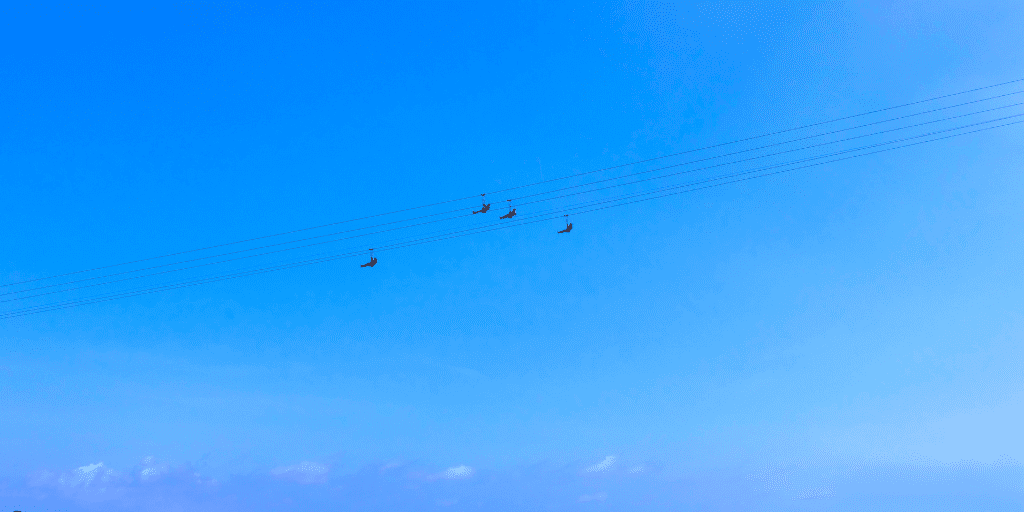
Running a high-volume zipline with passive trolleys puts a hard ceiling on what you can earn per hour. A rider reaches the landing platform — the trolley stays there, gear accumulates, and a second operator holds the next launch until the line is clear. Autonomous zipline technology replaces that model with a motorized, software-controlled system that returns the trolley, manages dispatch automatically, and keeps a single operator in control of the entire line.
Bi-directional operation and what it changes for the operator
Most commercial ziplines use gravity to move a rider from A to B. Once the trolley arrives at the landing platform, it stays there until someone brings it back. That retrieval step — whether done manually, by ATV, or by a secondary line — requires time, staff, and planning. Motorized zipline trolleys address that directly.
How does a motorized zipline trolley work?
A motorized trolley carries an internal drive mechanism that propels the unit along the cable in either direction. After a rider reaches the landing platform and disconnects, the trolley travels back to the launch point under its own power. The system is managed through a central control interface — typically a panel at the launch platform — that handles dispatch, speed targets, and interlock status.
How does bi-directional travel change the staffing requirement?
The direct consequence is that the landing zone no longer requires a dedicated operator. When the trolley returns itself, there is no equipment to retrieve, no signal to call back, and no second position to staff. A single launch-point operator can manage dispatch, fit the next rider, and monitor the system. For parks running multiple parallel lines, the staffing reduction compounds across every cable in operation.
Can the trolley carry equipment back to the launch platform?
Many motorized units are designed with a cargo function that returns harnesses and helmets to the start point after each ride. Throughput on a zipline depends not just on ride time but on how quickly the next rider can be equipped and staged. Removing the gear retrieval step eliminates one of the most consistent bottlenecks at the launch platform, particularly during peak-hour operation.
Speed regulation, dispatch control, and failsafe braking
Automation removes the most common source of safety incidents on ziplines: communication failures between staff. Digital control replaces the radio call and the visual check with software-enforced constraints.
How does programmable speed regulation work?
Operators set a target arrival speed for each rider, or the system derives it from participant weight and current wind data. The drive motor adjusts output continuously during descent to hit the landing platform within the programmed parameters. The result is consistent arrival speed regardless of conditions — without relying on a calibrated passive brake at the landing end.
How do digital interlocks prevent dispatch errors?
A digital interlock is a software gate that holds the launch mechanism closed until all safety conditions are confirmed. The system tracks the real-time position of every trolley on the cable. A second unit cannot depart until the line is confirmed clear — not by a staff call, but by the system itself. The mechanical launch gate is tied directly to the software state: if the parameters are not met, the gate does not open.
What failsafe braking does the system use if power is lost?
Failsafe design is a primary specification question for any autonomous system. The Mag Brake Trolley is one example of magnetic self-braking applied to zipline trolley design: the braking mechanism engages automatically without external power, bringing the rider to a controlled stop. Fully motorized autonomous systems typically rely on battery backup or a pre-engaged mechanical catch. Confirm the specific failsafe mechanism with the manufacturer before procurement.
Maintenance scheduling and operational uptime
An unplanned closure mid-season costs significantly more than a scheduled maintenance window. Motorized systems offer tools to shift the balance toward planned intervention.
How does automated cable inspection work?
A motorized trolley can run a slow-speed cable sweep with sensors monitoring tension, surface condition, and load deviation — without requiring a technician to ride the line. This supplements the inspection programme rather than replacing it: EN 13796 compliance still requires certified human inspection at the intervals set in your operations manual. What automated sweeps provide is more frequent data between those mandatory inspections.
What does predictive maintenance mean in practice?
The system logs cycle counts, load profiles, and performance deviations for each component. When a metric crosses a defined threshold, the software generates a service alert before a failure occurs. For operators planning maintenance budgets, this converts unpredictable repair costs into scheduled line items — and it reduces the risk of a component failing during a peak operating period.
Revenue opportunities and retrofit considerations
The commercial case for autonomous technology is strongest when throughput is the constraint. A single cable running more riders per hour at lower staffing cost pays back the capital investment faster than a second cable built from scratch.
How do programmable ride profiles support premium pricing?
The same cable can deliver a high-speed descent for adult riders and a slower scenic ride for mixed groups or younger participants — dispatched from the same platform, on the same infrastructure. Offering multiple distinct experiences multiplies revenue per installation. Some operators program a mid-ride pause at a viewpoint to create a 360° photo opportunity before the system automatically resumes, which supports a separate photo product upsell.
Can an existing zipline be converted to an autonomous system?
Many cables built for passive trolleys have the structural rating to support a motorized unit, but the conversion is not straightforward. Cable tension, anchor loading, platform clearances, and power supply routing all need assessment before a retrofit is confirmed viable. A design and engineering review before specifying a system saves significant cost if any structural modification turns out to be required.
Conclusion
Autonomous zipline technology addresses three interconnected constraints on zipline profitability: staffing cost, throughput ceiling, and ride quality consistency. The technology is commercially available at multiple specification levels. The right starting point is an assessment of your current throughput numbers, staff model, and infrastructure condition — before evaluating any specific system.
Contact us to discuss a tailored solution that uses programmable, autonomous technology to revolutionize your visitor experience!
Get in touch Today
Frequently asked questions
What is the typical installation timeline for an autonomous zipline system?
Timeline varies significantly depending on whether you are retrofitting an existing cable or building new infrastructure. A retrofit to an already-rated cable can be completed in days once equipment is on site. New infrastructure with power routing and structural modifications typically runs several weeks. The design and engineering phase — before any physical work starts — should be factored into the project schedule.
Does an autonomous zipline require a different insurance or certification approach?
EN 13796 governs cableway installations including motorized systems, and your insurer will require evidence of compliance and regular inspection regardless of automation level. Some insurers require additional documentation for motorized systems, particularly around failsafe braking and interlock certification. Confirm the specific requirements with your insurer and the system manufacturer before installation.
What power supply does a motorized zipline trolley require?
Power requirements vary by system. Some units carry onboard batteries charged at the launch platform between rides; others draw from a cable-mounted power supply running the length of the line. Onboard battery systems are easier to retrofit but add weight and require battery management as part of daily operations. Confirm power architecture early — it affects both the infrastructure cost and the operational workflow.
How do autonomous systems perform in cold-weather or high-humidity environments?
Motor performance, battery capacity, and sensor accuracy all degrade in low temperatures. Systems designed for year-round operation in variable climates carry rated operating temperature ranges that should be verified against your site conditions. Cable icing, condensation on sensors, and drive mechanism lubrication in cold conditions are all factors to address in the maintenance plan before the first winter season.
Does operating an autonomous zipline require specialist staff qualifications?
The automation logic handles braking, dispatch control, and safety interlocks — so staff no longer need manual braking competency at the landing zone. The skills focus shifts to system monitoring, harness fitting, and guest management at the launch platform. Manufacturer training is still required for the operator running the control interface, and EN 13796 inspection requirements remain in place regardless of automation level.
The Hardware Behind a Safe, High-Volume Zipline Operation
The products below are used and specified in the techniques described above. Click any item to explore full specifications and request a quote.
How Automatic Reset Braking Keeps High-Volume Ziplines Running
Magnetic eddy-current braking with automatic reset — ideal for high-throughput commercial courses where minimising staff intervention between riders matters.
Why Modular Spring Braking Is the Operator’s Safety Baseline
The modular go-to for operators who need reliable primary and emergency arrest capability. Configurable to your specific rider weight range and arrival speed.
What It Takes to Safely Stop a Rider Arriving at 72 km/h
Engineered for mega-ziplines running at up to 72 kph. The benchmark high-velocity arrest device for operators running the fastest commercial lines.
The Prone Position: How Superman Ziplines Demand Specialist Harnessing
The specialist prone harness for headfirst Superman configurations — redesigned for faster guest harnessing and a more comfortable ride position.
Trolley Longevity vs. Arrival Speed: Why You Don’t Have to Choose
Built to absorb the impact at landing without compromising speed on the line. The choice for courses where trolley longevity and smooth arrival are both non-negotiable.
Heavy Loads, Long Runs: Specifying Trolleys for Serious Commercial Operations
ISC’s large-capacity trolley for high-load commercial operations — built to the bearing quality and durability standards that serious operators expect.
Browse the full Zipline Safety Solutions range →
-
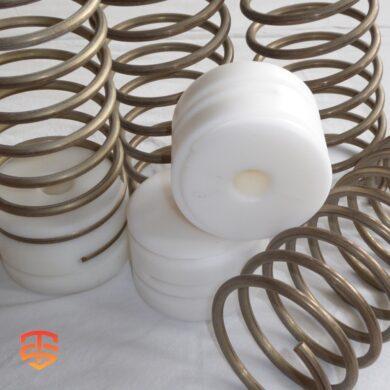 Zipline Spring Brake System | Primary & EAD Braking€ 90,00 Ex VAT
 -
Product on sale
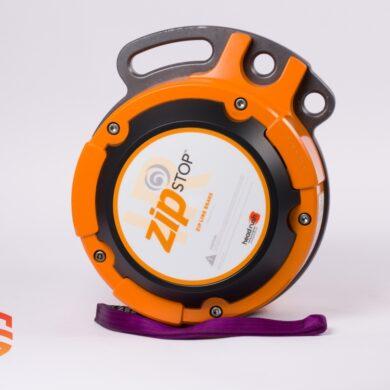 zipSTOP IR Zip Line Brake | Internal Reduction for High-Speed ArrivalPrice range: € 5.742,00 through € 5.894,00 Ex VAT
 -
Product on sale
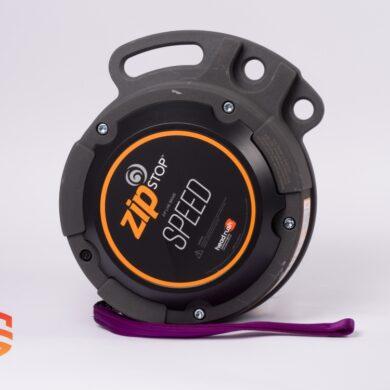 zipSTOP SPEED | High-Velocity Magnetic Braking SystemPrice range: € 6.198,00 through € 6.455,00 Ex VAT