Zipline Trolley Technology makes every zipline experience smooth and safe. Zipline trolley technology affects the ride from materials to braking systems to maintenance.
We provide expert articles and white papers on all elements of zipline trolley technology in this blog category. Our engineers, safety professionals, and experienced operators love sharing their zipline trolley technological knowledge.
Our blog covers trends, best practices, and safety for operators, engineers, and participants. We also review zipline trolley technology and equipment. This blog is for zipline operators, enthusiasts, and those interested in zipline trolley technology. Our Zipline Trolley Technologies blog provides expert analyses and insights.
Upgrading to autonomous zipline technology is the definitive way for modern commercial adventure parks to maximize operational throughput and visitor safety. By removing outdated manual retrieval processes, facility managers can instantly slash labor costs while keeping lines moving smoothly. Implementing this equipment transforms a standard attraction into a highly predictable, revenue-generating asset.
Selecting the right equipment is vital for the safety and profitability of any adventure park or commercial zipline operation. This professional comparison examines the technical differences between the Zippey, Zipspeed-S, and Zipspeed-L models. You will discover which hardware best suits your specific course length, speed requirements, and maintenance budget.
Spring 2025 ushers in an exciting update for the Zippey Clip’n’Zip Trolley and Anti-Rollback Cam (ARC) with the launch of three innovative safety accessories. Designed to enhance user protection and reduce the risk of finger trapping, these new additions are crafted from impact-modified nylon for maximum durability. Whether you’re upgrading your existing fleet or purchasing new trolleys, these accessories offer a seamless way to improve safety and compliance.
ZipTronik is a motorized, bi-directional zipline trolley: it travels down and back up the same cable under its own control. That removes the trolley and gear retrieval step from your operation, so one operator at the launch platform can run the line. Every ZipTronik installation is a project, configured for your cable, your site and your ride concept. This page explains how it works, where it fits and what we need from you to assess your line.
On a gravity zipline the trolley stays at the landing platform until someone brings it back: by hand, by ATV or on a secondary line. That takes time, staff and planning. A ZipTronik cart returns itself, which changes four things for the operator:
No operator at the landing zone. One operator at the launch platform handles dispatch, harness fitting and monitoring. On parks with parallel lines, the saving repeats on every cable.
No cart lift or retrieval line. You also need a smaller trolley fleet, because each cart cycles back to the start.
Gear comes back with the cart. Harnesses and helmets can return to the launch point after each ride, removing one of the most common bottlenecks at peak hours.
New course designs. Lines are no longer limited to downhill-only routes, so you can plan courses that a gravity system cannot run.
How ZipTronik works
ZipTronik combines mechanics, electronics, computing and communication in one autonomous, programmable cart. You program routes, speeds and the return to the start point, and the cart runs them without manual handling of the pulley.
Energy recovery
The cart stores energy during the descent and uses it to power the ascent. This regenerative charging lets it run many cycles autonomously and reduces the need for external power.
Speed regulation and braking
Speed is regulated continuously, and automatic braking brings each rider in under control. You can offer slow, medium or fast descent profiles, with consistent performance regardless of rider weight or weather.
Control, position detection and data
Depending on model and application, carts run fully autonomous, semi-automatic or manual, and can be operated remotely. Position detection tracks each cart on the cable for accurate targeting, and certain models pass intermediate pylons. Real-time data shows how the line is used, and the cart can run periodic cable inspections at reduced speed.
Three cart types
ZipTronik LOADER for equipment transport: motorized trolley with automatic lift, interchangeable battery for continuous operation, remote control and position detection. It handles intermediate pylons and varying slopes.
ZipTronik for passenger transport: self-regenerative charging, speed regulation, automatic lift, advanced position detection, remote control and intermediate pylon passage.
ZipTronik-SPEED for passenger transport where a lightweight, compact cart fits best: regenerative charging and speed regulation, suitable for a wide range of installations and rider weights and heights.
Where it fits
Rider return on single lines, so trolleys never have to be carried back.
Gear retrieval of harnesses, helmets and other equipment.
Cargo transport across a course or site with the LOADER.
Several ride profiles on one cable: a fast ride for adults and a slower scenic ride for families, from the same platform. A programmed pause at a viewpoint can support a 360° photo or video product.
Branded attractions: carts can be finished in your logo and colours.
Retrofit or new build
Many cables built for passive trolleys can carry a motorized unit, but a conversion needs checking first: cable tension, anchor loads, platform clearances and the power arrangement. A design and engineering review before you choose a system avoids costly surprises. A retrofit on an already-rated cable can be done in days once the equipment is on site. New infrastructure with structural work typically takes several weeks, plus the design phase.
How a ZipTronik project runs
You send us your line data (see the list below).
We check feasibility: cable, platforms, power and the ride concept.
You receive a proposal with cart type, configuration and price.
Delivery and commissioning, with manufacturer training for your operators.
What we need from you
Application: rider return, gear retrieval, cargo or a ride experience
Line length, height difference and number of lines
Cable type and diameter
Existing line or new build
Location and climate, including the lowest operating temperature
Expected riders per hour and your season
Planned timing
Send these details to sales@thrillsyndicate.com and we will come back with a first feasibility check.
Frequently asked questions
Can a motorized zipline trolley go uphill?
Yes. ZipTronik travels in both directions on the same cable. Energy recovered during the descent powers the ascent.
Is ZipTronik remote controlled?
Yes, ZipTronik carts can be operated remotely. Depending on the model and application, they run fully autonomous, semi-automatic or manual.
What power supply does a motorized zipline trolley need?
It depends on the model and the line. The LOADER uses an interchangeable battery for continuous operation, and the passenger carts recover energy on each descent. Settle the power set-up early in the project, because it affects both the infrastructure cost and the daily workflow.
Does it work in cold or wet weather?
ZipTronik carts are built for a wide range of weather conditions. Check the rated operating temperature against your site, and plan for cable icing, condensation on sensors and cold-weather lubrication in your maintenance plan before the first winter.
Which standards apply to a motorized zipline?
EN 13796 covers cableway installations, including motorized systems. Your insurer will want evidence of compliance and regular inspection, and some insurers ask for extra documentation on failsafe braking and dispatch interlocks. Confirm these requirements before installation.
Do staff need special qualifications?
Staff no longer need manual braking skills at the landing zone; the focus moves to system monitoring, harness fitting and guest management at the launch platform. The operator running the control interface needs manufacturer training, and the EN 13796 inspection requirements stay in place.
Contact us to discuss a tailored solution that uses programmable, autonomous technology to revolutionize your visitor experience!
Magnetic eddy-current braking with automatic reset — ideal for high-throughput commercial courses where minimising staff intervention between riders matters.
The modular go-to for operators who need reliable primary and emergency arrest capability. Configurable to your specific rider weight range and arrival speed.
Built to absorb the impact at landing without compromising speed on the line. The choice for courses where trolley longevity and smooth arrival are both non-negotiable.
ISC’s large-capacity trolley for high-load commercial operations — built to the bearing quality and durability standards that serious operators expect.
The brake decides three things on a commercial zipline: how safely every rider stops, how many riders you get through per hour, and how much you spend on wear parts. This guide compares the main options (active braking, gravity, spring and magnetic brakes, plus emergency arrest devices) so you can choose the right system for your line.
Active or passive braking?
With active braking the rider does the work, usually with a leather glove or a brake pad pressed onto the cable. It is cheap to start with, but it depends on every rider braking at the right moment. Riders who are nervous, distracted or simply too young brake too late, too early or not at all. Hands come close to the cable and trolley, and the friction wears out gloves, pads and the cable itself.
With passive braking the system stops the rider without any action from the rider or a staff member. That removes the most variable link in the braking chain, human reaction, and staff no longer need to manage the stop at the landing zone. For commercial lines, passive braking is the standard.
The passive options compared
Brake type
How it stops the rider
Same feel for light and heavy riders?
Reset between riders
Wear
Best use
Gravity
An uphill end section slows the rider, who rolls back to the low point
No: lighter riders stop short, heavier riders arrive fast
None, but riders swing back and forth before stopping
Low
Short, slow lines with plenty of cable to spare
Spring brake
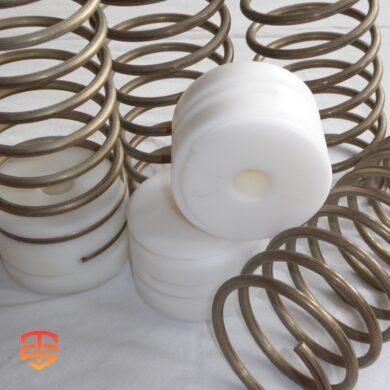
Stainless steel springs and spacers compress and absorb the arrival speed
Partly: configure the pack for your lightest and heaviest rider
Springs return by themselves
Low; inspect regularly for corrosion
Primary brake on moderate-speed lines, or as an emergency arrest device
Magnetic (zipSTOP)
Eddy current braking slows the brake trolley in proportion to arrival speed
Yes: braking force adjusts to each rider automatically
Automatic
No friction parts in the braking core
High-throughput and high-speed commercial lines
Gravity braking
A gravity brake is really the absence of a brake. The cable is set with enough sag that its last section runs uphill, and the rider slows, rolls back and settles at the low point. It only works on shallow, slower lines, it wastes the end of your cable and terrain, and riders who swing back and forth add waiting time without adding experience. Stopping at a raised platform is hard, because every rider arrives at a different point.
Spring brakes
A spring brake is a stack of stainless steel springs with nylon spacers on the cable. The springs compress and absorb the rider’s speed. Because the pack is modular, you set its length and force for your arrival speed and your rider weight range. Rider weight, wind and a wet or dry cable still change the stopping distance and the rebound, so the configuration has to be calculated properly. Our Zipline Spring Brake works as a primary brake or as an emergency arrest device; the spring brake guide shows a worked sizing example.
Magnetic brakes: the zipSTOP family
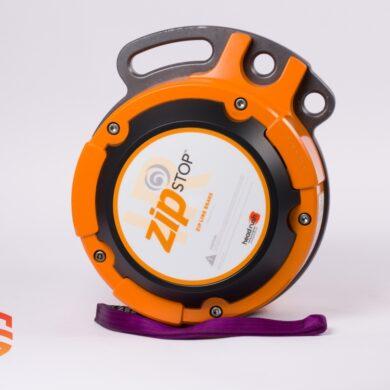
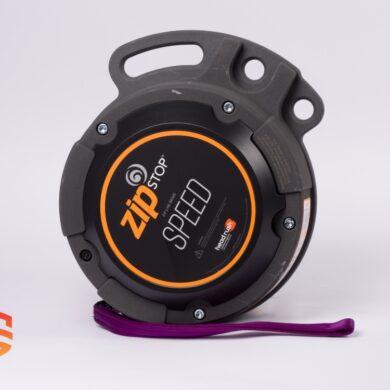
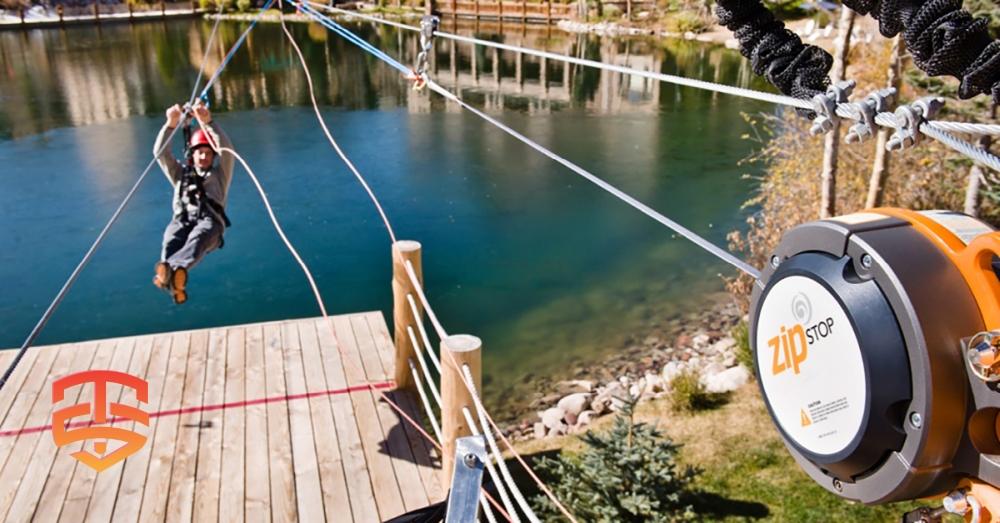
The zipSTOP uses eddy current magnetic braking, so there are no friction pads or wearing parts in the braking core. The braking force self-regulates to each rider’s arrival speed, so a child and an adult feel the same smooth stop. The brake resets automatically after every ride, and its brake trolley can be fitted with a catch mechanism that works with the Impact Trolley, which makes retrieving the rider faster. Three models cover different speeds:
zipSTOP Zip Line Brake for standard commercial lines, from €5.334 ex VAT.
zipSTOP IR with internal reduction for high-speed arrival, from €5.742 ex VAT.
zipSTOP SPEED for the fastest lines, rated for arrival speeds up to 72 km/h, from €6.198 ex VAT.
Revolutionizing Trolley Technology: The Mag Brake Trolley
Emergency arrest devices
An emergency arrest device (EAD) is a second, independent brake that stops the rider if the primary brake fails. It is not optional: EN 13796 and standard commercial practice require a secondary arrest system on participant-carrying ziplines, and ACCT guidance requires one on lines faster than about 10 km/h. An EAD that never activates in normal operation is doing its job.
Spring pack as EAD: a shorter spring pack behind the primary brake. At 25 km/h, for example, the calculation gives 15 springs and a pack of about 4,8 m.
Zipline Airbag EAD: a high-visibility, cushioned last stop at the end of the line, €2.500 ex VAT.
Size the EAD for the maximum arrival speed, test primary brake and EAD with unoccupied loads before opening, and document the results in the commissioning record.
How to choose the right brake
Arrival speed: the faster riders arrive, the stronger the case for a magnetic brake (zipSTOP IR or SPEED on fast lines).
Rider weight range: if children and adults share the line, a self-regulating magnetic brake gives the most consistent stop.
Throughput target: automatic reset and a trolley catch save seconds on every rider, which adds up on busy days.
Staffing: passive braking removes the need for a person braking riders at the landing.
Budget and line profile: on a moderate-speed line, a correctly sized spring brake is a reliable, low-cost primary brake.
Always: a separate emergency arrest device behind the primary brake.
Not sure? Send us your line length, height difference, expected arrival speed and rider weight range, and we will recommend and size a braking system.
Choosing a brake for your line? The zipSTOP brake guide compares zipSTOP, zipSTOP IR and zipSTOP SPEED by arrival speed and price.
Frequently asked questions
What is the best brake for a commercial zip line?
For high-throughput or fast lines, a passive magnetic brake such as the zipSTOP gives the most consistent stop and resets automatically. On moderate-speed lines, a correctly configured spring brake is a reliable and cheaper primary brake. Every line also needs an emergency arrest device.
Is a gravity brake safe enough?
It can work on short, slow lines, but it gives inconsistent stops across rider weights, wastes cable and terrain, and slows throughput. For commercial lines, a passive brake plus an emergency arrest device is the better choice.
Can a spring brake be the primary brake?
Yes, when the spring pack is calculated for your arrival speed and your lightest and heaviest rider. Expect some rebound and check the configuration under wet and windy conditions.
Do zip lines need an emergency arrest device?
Yes. EN 13796 and standard commercial practice require a secondary arrest system on participant-carrying ziplines, independent of the primary brake.
How much does a zip line brake cost?
Spring brake sections start at €90 ex VAT each, and a complete pack depends on its length. The zipSTOP starts at €5.334, the zipSTOP IR at €5.742 and the zipSTOP SPEED at €6.198 ex VAT. The Zipline Airbag EAD is €2.500 ex VAT.
Planning a zipline installation? Need expert advice on zipline design?
Magnetic eddy-current braking with automatic reset — ideal for high-throughput commercial courses where minimising staff intervention between riders matters.
The modular go-to for operators who need reliable primary and emergency arrest capability. Configurable to your specific rider weight range and arrival speed.
Built to absorb the impact at landing without compromising speed on the line. The choice for courses where trolley longevity and smooth arrival are both non-negotiable.
ISC’s large-capacity trolley for high-load commercial operations — built to the bearing quality and durability standards that serious operators expect.
Discover the latest revolution in adventure park technology: the magnetic zipline trolley. While trolley systems are evolving with features like multi-rider options, the introduction of magnetic braking is a true game-changer. Unlike traditional trolleys that rely on friction, the magnetic zipline trolley uses powerful neodymium magnets to provide a smooth, controlled, and exceptionally reliable stop. This guide explains how this technology enhances rider safety, offers variable speed control for a customized experience, and drastically reduces maintenance costs by eliminating brake pads and other wearing parts. Learn why this state-of-the-art system is becoming the preferred choice for operators seeking to improve both safety and the guest experience.
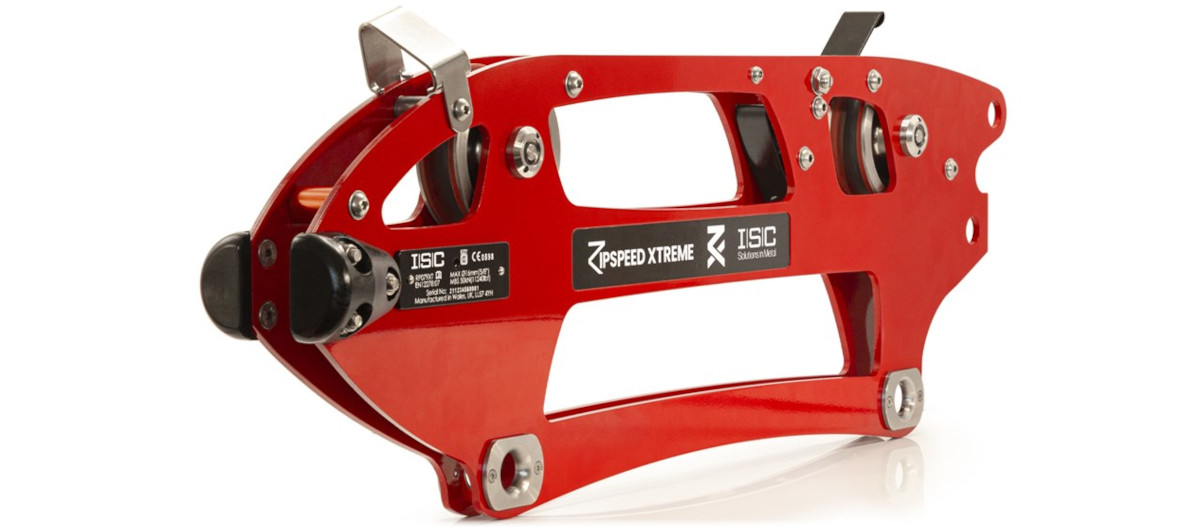
Introducing the ISC ZipSpeed XTREME Trolley, the premier choice for high-speed zip lines where noise reduction is critical. Developed in collaboration with the world’s fastest zip line, this trolley is engineered to perform at over 160 km/h while significantly reducing sound output. This is a crucial advantage for operators seeking planning permission near residential or wildlife areas. The innovative design features noise-dampening polyurethane tires and a unique Noise Reduction Anti-Rollback Cam (NRARC) that uses an ‘air paddle’ to prevent contact and noise during the ride. Durable, fast, and remarkably quiet, the ISC ZipSpeed XTREME Trolley is the ultimate solution for high-throughput attractions that demand world-class performance and minimal environmental impact.
Specifying a commercial zipline means making decisions about a system, not a product. The cable, the trolley, the primary brake, the emergency arrest device, the platforms, and the inspection programme all interact — a choice made at one point affects what is possible at another. This overview covers each component in sequence, with the decisions and constraints operators need to understand before committing to a design. Use it as a checklist before you request quotes or brief an engineer.
The zip line trolley bearings might be a small component, but they are crucial to the speed, smoothness, and lifespan of your equipment. In many trolleys, bearings are the first point of failure, leading to costly replacements and downtime. This guide explains why high-quality bearings matter so much. We break down the components of a bearing and explore the key features that separate a superior product from the rest, such as ABEC ratings for high-speed performance, durable steel cages that resist heat, and metal shields for long-term protection. Learn how investing in trolleys with precision-engineered bearings can extend the life of your fleet and improve your overall return on investment.
The MAG Brake Trolley is a revolutionary magnetic zipline trolley that uses proven Eddy Current technology to automatically regulate rider speed. Designed for steep, long, and fast courses, this self-braking pulley reduces speeds by up to 35% without friction, heat, or cable wear. This innovative design ensures all riders, regardless of weight or weather conditions, arrive at the landing area at a consistent and safe speed. By integrating the brake into the trolley itself, you can eliminate the need for complex, high-maintenance braking areas, reducing construction costs and your environmental footprint. Experience a safer, more reliable, and lower-maintenance solution for your high-performance zip line.