
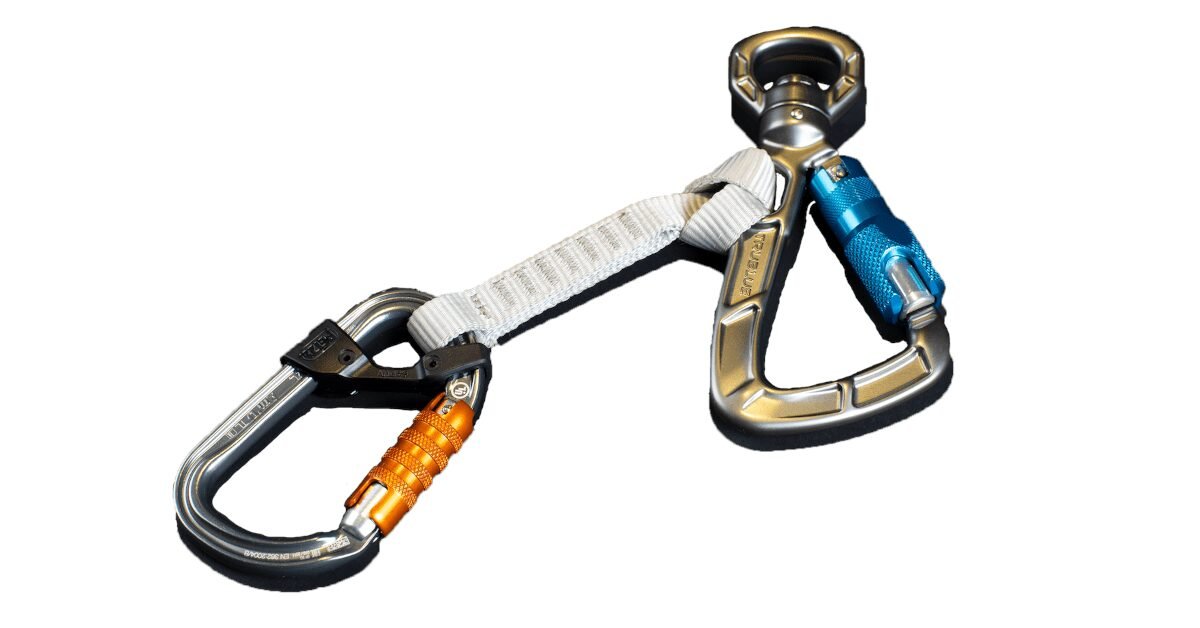
The weakest point of any auto belay is the moment a climber clips in. A carabiner on a gear loop, a gate that does not close, a climber who forgets to connect at all: these are the incidents operators fear most. The TRU-LOCK carabiner is built to make that moment more reliable, and its optional dual connection adds a full-strength backup. This article explains what the carabiner does, when a dual connection is worth it for your wall, and which parts the secondary connector needs. A belay gate in front of each lane adds a second barrier: the climber cannot start until the gate is open and the carabiner is clipped.
What the TRU-LOCK carabiner is
TRU-LOCK is the connector at the end of the webbing on TRUBLUE auto belays. All current TRUBLUE devices and replacement webbings ship with it as standard. Three design features matter for operators:
- Triple-stage automatic locking gate. Precise gate machining limits dynamic rollout and premature gate wear. The textured gate collar is easy to operate with chalky or wet hands, and the no-snag nose gives a clean, positive closure.
- Swivel for flat webbing. A polymer bushing swivel resists corrosion and rotates freely, so the webbing does not twist when climbers spin on the wall.
- Integrated secondary attachment point. A full-strength, rated connection point on the spine of the carabiner lets you add a second connector to the climber without losing the swivel function.
The body is forged from anodised 7075-T6 aluminium with an I-beam profile. It is third-party tested for strength and compatibility with international standards, and it is one of the most compact ANSI-rated aluminium swivel carabiners available.

Why add a dual connection?
A dual connection links the climber to the auto belay twice: once with the TRU-LOCK carabiner and once with a short secondary sling and carabiner. If the climber or staff member makes a mistake with one connection, the other still holds. The secondary connector is not loaded in normal use; it only takes load if the primary connection fails.
It is most useful where the risk of incorrect attachment is highest:
- Busy recreational walls with many first-time climbers, birthday parties and school groups.
- Facilities where one staff member supervises several auto belay lanes.
- Competition and speed climbing, where climbers clip in under time pressure.
A dual connection does not replace supervision or a physical barrier. Combine it with a belay gate that blocks the climbing surface until the climber is clipped in, and with a clear check routine for staff. For the full set of requirements, read our guide to the new auto belay safety standards.
Secondary connector requirements
The manufacturer sets clear rules for the secondary hardware. Use this as a checklist before you build or buy a system:
| Component | Requirement | Why |
|---|---|---|
| Sling | Nylon (polyamide) or polyester, certified to EN 566, 13 mm wide or more | Girth hitches strongly reduce the strength of aramid and UHMWPE (Dyneema, Spectra) slings |
| Connection to TRU-LOCK | Girth-hitched sling, never a metal connector | A metal connector in the secondary point can be cross-loaded or levered |
| Climber-side carabiner | Triple-locking, certified to EN 362 | Same locking standard as the primary connection |
| Carabiner retention | Lanyard keeper or captive-eye carabiner | Keeps the carabiner oriented and attached to the sling |
| Length | As short as possible, not loaded in normal use | A long sling can snag and adds fall distance |
Our TRU-LOCK Security Kit for TRUBLUE Dual Connection contains a set of secondary hardware for this purpose, so you do not have to source the parts yourself.
How to connect the climber
If your operation allows it, the climber can be connected to both connectors at the same rated harness attachment point, or to two separate rated attachment points. Where possible, the gates of the two carabiners should face opposite directions. Brief your staff to check both connections at the start of every climb, just as they check the primary carabiner today.

secondary connection to the climber. This integrated backup option can be used for recreational or competition climbing to minimize the possibility of incorrect user attachment.
Operational considerations
- Inspection: loosen and inspect the girth hitch regularly for wear, and add it to your daily pre-use check of the webbing and carabiner.
- Orientation: because the secondary connector is unloaded, it tends to rotate into a cross-loaded or gate-loaded position. A lanyard keeper or captive-eye carabiner prevents this.
- Return: make sure the secondary connector stays on the TRU-LOCK carabiner and is not left on a harness after the climb.
- Service: TRUBLUE auto belays need an annual service and recertification. Worn webbing and connectors are replaced with TRUBLUE replacement webbing, which comes with the TRU-LOCK carabiner fitted.
Want to understand what happens inside the device when a climber falls or lets go? See how an auto belay works and how the braking systems compare.
Frequently asked questions
Is the dual connection mandatory on TRUBLUE auto belays?
No. The secondary attachment point is an option. Whether you use it is part of your own risk assessment, based on your climbers, staffing and the type of climbing on the wall.
Can I use a Dyneema sling for the secondary connector?
The manufacturer advises against it. Aramid and UHMWPE slings such as Dyneema and Spectra lose a large part of their strength in a girth hitch. Use a nylon or polyester sling of at least 13 mm, certified to EN 566.
Does the TRU-LOCK carabiner fit my existing TRUBLUE auto belay?
Current TRUBLUE devices and replacement webbings ship with the TRU-LOCK carabiner, including the integrated secondary attachment point.
How often should the secondary connector be inspected?
Check it daily together with the webbing and primary carabiner, and loosen the girth hitch regularly to look for wear. The auto belay itself needs an annual service and recertification.
Ready to add a dual connection to your TRUBLUE auto belays? Request a quote for the TRU-LOCK Security Kit and we will check compatibility with your devices.
What to Consider Before You Spec an Auto Belay System
The systems and accessories discussed above are used on professional climbing walls worldwide. Explore each to find the right fit for your wall configuration and operational setup.
Auto Belay Buying Guide: What to Look For Before You Spec a Climbing Wall
Wall height, expected cycle counts, and your inspection regime all influence which auto belay system belongs on your wall. Browse the full range of certified vertical auto belay systems for commercial climbing operations.
Why the TruBlue IQ Is the Default Choice for High-Traffic Climbing Walls
The TruBlue IQ combines magnetic braking with a speed-sensing mechanism that adjusts descent rate to the climber’s weight — delivering a smooth, controlled lowering experience for every rider regardless of size.
Speed Climbing and Auto Belay: What Changes When Every Second Counts
Speed climbing demands a faster retraction rate than recreational walls require. The TruBlue Speed is engineered specifically for competition and training walls where rapid reset between attempts is part of the format.
When to Replace Your Auto Belay Webbing — and What Happens If You Wait Too Long
Webbing is the most wear-exposed component in any auto belay system. Browse certified TruBlue replacement webbing and understand the inspection intervals that keep your units in service and your liability in check.
The Connector Your Climbers Use Every Single Session: Why It Deserves More Attention
The Tru-Clip is the interface between your climber and the auto belay system — designed for one-handed connection, misuse resistance, and the thousands of attach-detach cycles a busy wall puts it through every month.
The Sensor That Catches What Staff Can’t Always See
The Tru-Alert height sensor monitors climber position and triggers an alert when someone reaches the top unclipped. It is the operational safety net for busy walls where staff cannot maintain a direct sightline to every route at all times.
Browse all Vertical Auto Belay Systems →
-
Product on sale
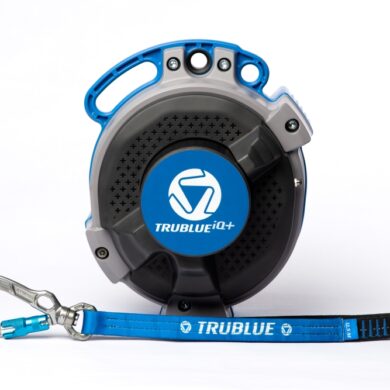 TRUBLUE iQ+ Auto Belay | Catch-and-Hold Projecting TechnologyPrice range: € 4.465,00 through € 5.157,00 Ex VAT
-
Product on sale
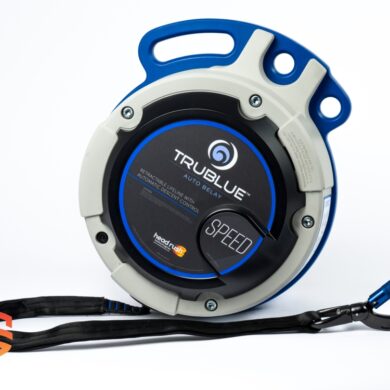 TRUBLUE Speed Auto Belay | Competition-Grade Speed Climbing SystemPrice range: € 2.845,00 through € 3.360,00 Ex VAT
-
Product on saleTRUBLUE iQ Auto Belay – Magnetic Auto Belay System for Climbing WallsPrice range: € 2.845,00 through € 3.465,00 Ex VAT